
Problems & Solutions: Precure's View on Work-Related MSDs and How to Reduce Them
Lifting work environment efforts to the next level
As a modern society with smart, sustainable companies, we have come a long way regarding occupational health and safety (OHS). We, as companies, understand that our employees are our most valuable asset. The efforts to maintain their ability to work have therefore risen to the top of priorities. However, MSD and related problems are still a major cause of sick leave and lowered quality of life. PRECURE set out to solve this issue and we are proud to share the result with you.
Introduction
The statistics on work-related MSD, related sick leave and costs (direct and indirect) paint a rather dark picture.1 MSDs are problematic because they develop gradually, almost without any warning, eventually becoming chronic and difficult to treat. Whether we work in an office or do manual labour, we are at risk of developing an MSD. Every time we enter the workplace, be it the kitchen table or the warehouse floor, we are at risk. The best way of preventing problems is preventing the onset of MSD by reducing the sources that cause unhealthy activities and empowering the employee to adopt healthy behaviour patterns.
Introduction to the problem
Let’s take the office environment as an example. A workplace assessment is carried out every year to check that the workplace is up to standards. Investments are made to provide the employees with state-of-the-art tables, keyboards, mice, massage programs, physiotherapy consultations and gym memberships, among others. Another environment, like a warehouse, has assessed its processes and invested in high-quality assistive devices to reduce unnecessary manual labour. Still, too many employees each year report a musculoskeletal disease, such as tennis elbow and lower back pain. So far, despite our best HSE efforts, we have not been able to eliminate many of the issues that lead to pain and sick leave.
General pain points and the basis for our solution
The reasons why we are struggling with work-related MSD are many. Our experience and scientific research2 show that a few challenges persist:
- Health and safety specialists are physically unable to pick up on every harmful movement of every employee, especially those that accumulate gradually over a longer period.
- General health, safety and ergonomic education often lacks behavioural change and long-term effects.
- Employees prioritise productivity over safety and overlook danger zones.
- Compliance with manual handling procedures is lacking.
- There is limited data insight into the situation and the causes of the strain.
- Companies and OHS professionals lack a tool that enables the data-based decision-making needed to reach their goals.
Our solution
“This is not right, and it is not sustainable. There must be a better way.”
Those were some of the thoughts that led to the solution that PRECURE developed. The core solution is based on collecting relevant data to empower the user to learn and maintain healthy behaviour while working. In turn, the analysis of the user’s activity patterns and strain levels shows how the workplace design, processes, tools and techniques can be improved to create a healthier work environment. The two main data sources are wearable devices, which sense the user’s motion and muscle activity, and a mobile app.
The value of the solution is twofold. Firstly, it informs users when they reach high levels of strain and helps them react to the information. Secondly, this user information combined with company-specific insights (such as processes and tools) allows the correct OHS measures to be implemented at a workplace. This is presented in a near real-time dashboard that provides new information to strengthen decision-making.
In other words: where we previously relied on one-time assessments, we can now make a more specific, long-term, data-based assessment. The tool enables an assessment of an individual’s strain levels, of a specific task or of an entire process, to expose the real danger zones and risk areas. Previously, we have not been able to get this information anywhere. Now, we can prioritise OHS specialist resources where they are most needed, and allocate time and effort to the individuals or tasks that need help the most. Essentially, it is a question of working smarter with existing resources, instead of doing more of the same.
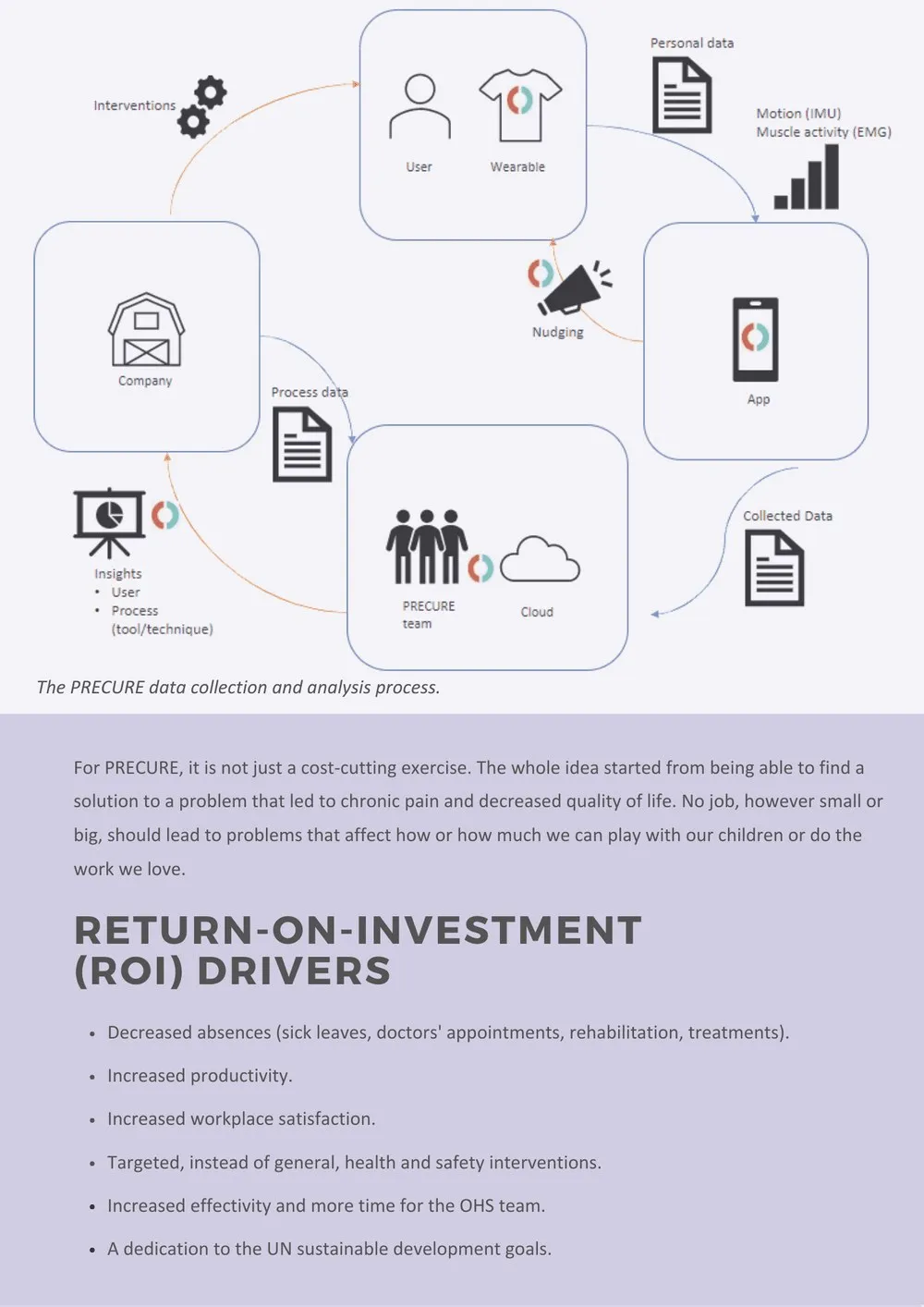
The PRECURE data collection and analysis process.
For PRECURE, it is not just a cost-cutting exercise. The whole idea started from finding a solution to a problem that led to chronic pain and decreased quality of life. No job, however small or big, should lead to problems that affect how much we can play with our children or do the work we love.
Return on investment (ROI) drivers
- Decreased absences (sick leave, doctors’ appointments, rehabilitation, treatments)
- Increased productivity
- Increased workplace satisfaction
- Targeted, instead of general, health and safety interventions
- Increased effectiveness and more time for the OHS team
- A dedication to the UN Sustainable Development Goals
Conclusion
Technological advances make it possible to work smarter than ever before. Through data collection, analysis and relevant interventions, the possibilities are endless. Imagine a world where no one has pain due to work, because we can prevent it by simply wearing clothes that sense when we are at risk. These clothes become our superpower that helps us prevent MSDs.
We started in 2016 with a solution for the elbow, and now we have a solution that tackles back pain, the leading work-related musculoskeletal disorder. You have also been given a glimpse of the ROI drivers when applying digitalisation and technology to enhance traditional OHS measures. Everything comes with a cost and we understand that. We firmly believe that our solution will help companies save money, not spend more of it. Money, like health, does not grow on trees after all. We hope that by reading this article, you are better equipped to evaluate your business’s dependency on traditional work environment measures, and whether you are ready to take your OHS operations and results to the next level.
If you have any questions, we encourage you to reach out to us at PRECURE, and together we will find a solution that fits your needs.
Footnotes
-
European Agency for Safety and Health at Work, 2020, Work-related musculoskeletal disorders: facts and figures. ↩
-
European Agency for Safety and Health at Work, 2020, Work-related musculoskeletal disorders: from research to practice. What can be learnt? ↩